
Designing an Incident Response Framework That Protects Engineering Focus
March 7, 2026
Designing an Incident Response Framework That Protects Engineering Focus
Why Incident Management Matters
As product teams grow, production incidents become inevitable. Bugs, unexpected system behavior, and customer-reported issues can quickly derail development if they are handled reactively. In many teams, incidents create constant interruptions:
- Engineers get pulled into debugging unexpectedly
- Product work slows down
- Stakeholders push for immediate fixes
- Priorities become unclear
Without a structured approach, engineering teams end up operating in reactive mode. To solve this, I introduced a lightweight incident response and triage framework designed around three principles:
- Protect engineering focus
- Prioritize issues based on real customer impact
- Create transparency across product and customer teams
This system allows the team to stay responsive to production issues while maintaining delivery momentum.
The Incident Response Philosophy
A common mistake in incident management is assuming every bug requires immediate engineering attention. In reality, not all incidents carry the same business impact. A mature engineering organization focuses on:
- Rapid response for critical issues
- Structured prioritization for non-critical issues
- Clear communication with stakeholders
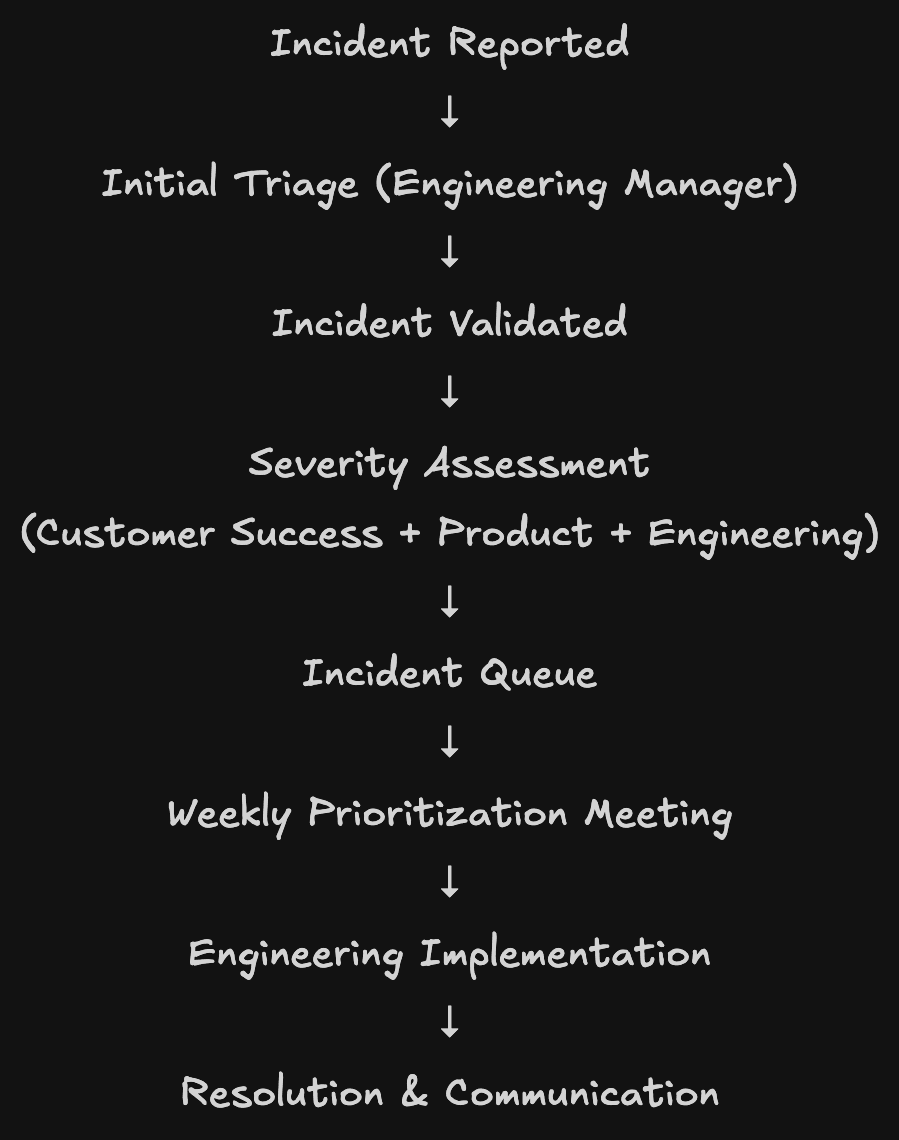
The framework I implemented focuses on structured triage, transparent prioritization, and predictable response times.
Step 1 — Centralizing Incident Intake
The first improvement was establishing a single entry point for incidents. Instead of engineers being interrupted directly by incoming issues, I take the role of initial incident responder.
When an issue is reported, I perform the first level of triage:
- Review the report
- Attempt to reproduce the issue
- Validate whether it is a real incident
- Assess potential system impact
- Add the issue to the incident queue
This approach has two major benefits:
- Protecting Engineering Focus: Engineers remain focused on prioritized work instead of reacting to every report.
- Improving Incident Quality: Many reports are incomplete or unclear. Early triage ensures that only actionable incidents reach the engineering team.
Step 2 — Cross-Functional Severity Assessment
After triage, incidents are evaluated collaboratively to determine severity and priority. Three teams contribute to this assessment:
- Customer Success: Provides visibility into customer impact and urgency.
- Product Management: Evaluates product functionality impact and roadmap implications.
- Engineering: Assesses technical complexity and potential system risk.
This cross-functional approach ensures incidents are prioritized based on real user impact rather than internal assumptions.
Step 3 — Defining Clear Severity Levels
To create predictable expectations, we introduced severity levels with defined response timelines.
- S0 — Critical: Immediate response required. These incidents typically involve production outages or major customer impact.
- S1 — High Priority: Significant functionality is affected. Target resolution within approximately one week.
- S2 — Medium Priority: Minor bugs or non-critical issues. Addressed within the next two to three weeks.
This system helps stakeholders understand that not every issue requires immediate engineering intervention, while ensuring critical problems receive rapid attention.
Step 4 — Maintaining a Transparent Incident Queue
All incidents are maintained in a shared queue visible to relevant teams.
This queue includes:
- incident description
- severity level
- customer impact
- current status
- expected resolution timeline
The goal is to eliminate ambiguity around:
- what issues exist
- which issues are prioritized
- when they will be addressed
Transparency significantly reduces internal pressure and repeated escalation requests.
Step 5 — Weekly Cross-Team Incident Prioritization
To maintain alignment, we established a weekly incident review meeting.
Participants include:
- Customer Success
- Product Management
- Engineering
During this session we:
- Review all open incidents
- Adjust priority if necessary
- Confirm upcoming fixes
- Communicate progress across teams
This meeting ensures prioritization decisions are made collectively and transparently.
The Impact
This framework produced several meaningful improvements:
- Engineering Focus Increased Developers were no longer constantly interrupted by incoming bug reports.
- Stakeholder Expectations Improved Clear response windows reduced uncertainty around incident resolution.
- Better Cross-Team Alignment Customer-facing teams gained visibility into engineering priorities.
- Reduced Operational Chaos Incidents moved through a predictable and structured process.
Lessons for Engineering Leaders
Several principles proved essential to making this system effective:
- Centralize incident intake - A single triage owner prevents operational chaos.
- Keep the process lightweight - Overly complex incident processes slow teams down.
- Include customer-facing teams - Customer Success and Product teams provide critical prioritization context.
- Communicate clearly - Transparency is often more valuable than speed.
Final Thoughts
Incidents are an unavoidable part of operating modern software systems. The goal of an incident framework is not simply to resolve bugs faster, but to balance responsiveness with sustainable engineering practices. By introducing a clear triage process, severity framework, and cross-team prioritization model, we created a system that allows engineering teams to remain focused while still responding effectively to production issues. For engineering leaders, operational frameworks like this often have a larger impact on team performance than any single technical improvement.